
Back to Portfolio
AI Platform
Dev Tools
Assessment
RustSkill
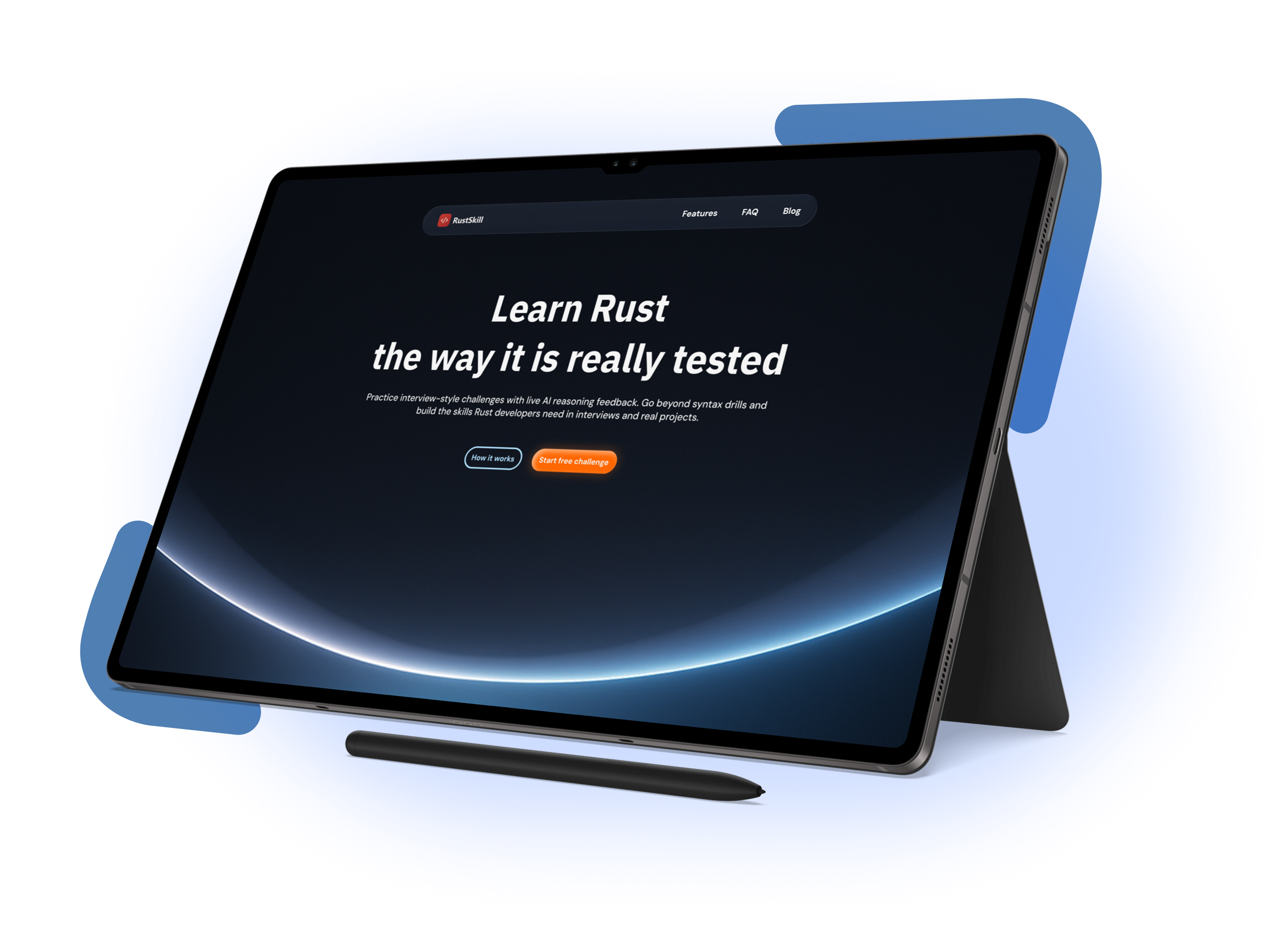
An AI-powered technical assessment platform built for real Rust coding evaluation, with a modern developer-focused interface.

Context
Technical assessments rarely evaluate real skills. Most platforms rely on theoretical quizzes, generic challenges, or workflows that demand unnecessary engineering time. Candidates also face slow, unclear, and often irrelevant testing experiences.
RustSkill solves this by offering a real coding environment, powered by AI insights, in a clean and transparent interface.


Role
UX Designer, UI, IA, flows, visual identity.

Timeline
2025

Team
Independent project (with developers collaboration)

Scope
Full product creation: onboarding, challenge builder, code execution interface, AI evaluation layer, dashboards, admin tools.
Impact
Defined the entire product experience for an AI-powered learning platform—from the core journeys to the interaction patterns—creating a clear, motivating workflow that helps developers practice Rust with real-time reasoning feedback. Built a scalable design system, streamlined the challenge flow, and shaped an interface that makes complex technical learning feel intuitive and actionable.
Challenges
For companies

No accurate Rust-specific evaluation tools
Manual review consumes engineering time
Scoring is inconsistent or opaque
Difficulty comparing candidates objectively
For candidates
Long, unclear assessment processes
Poor or no feedback
Outdated interfaces that add friction
Tests that don't reflect real work

My approach
1
Map the real workflow
Studied hiring practices and developer frustrations to identify the true gap: a fast, transparent, real-code assessment experience.
2
Define core product principles
Identified common tasks, eliminated redundant steps, and reorganised the information architecture around clarity and standardisation. Goal: one platform tha t adapts to multiple departments without fragmenting the experience.
3
Design the end-to-end experience
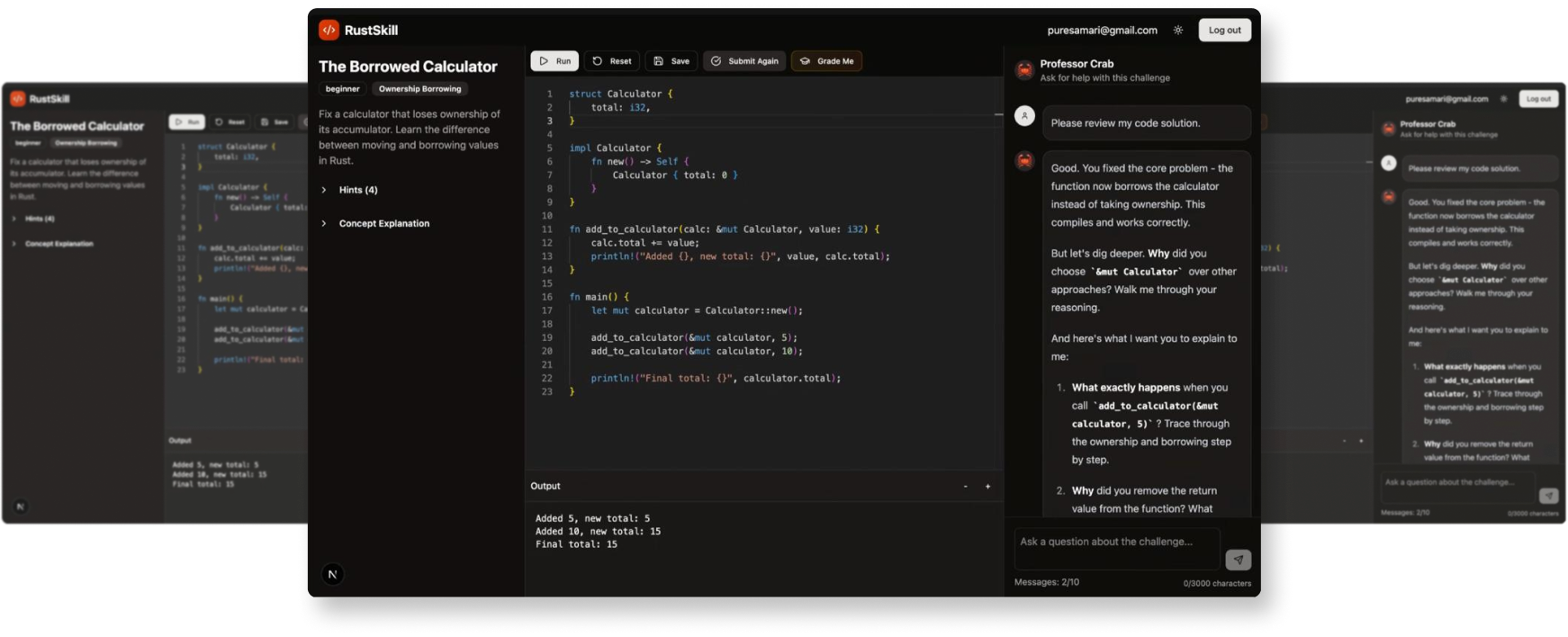
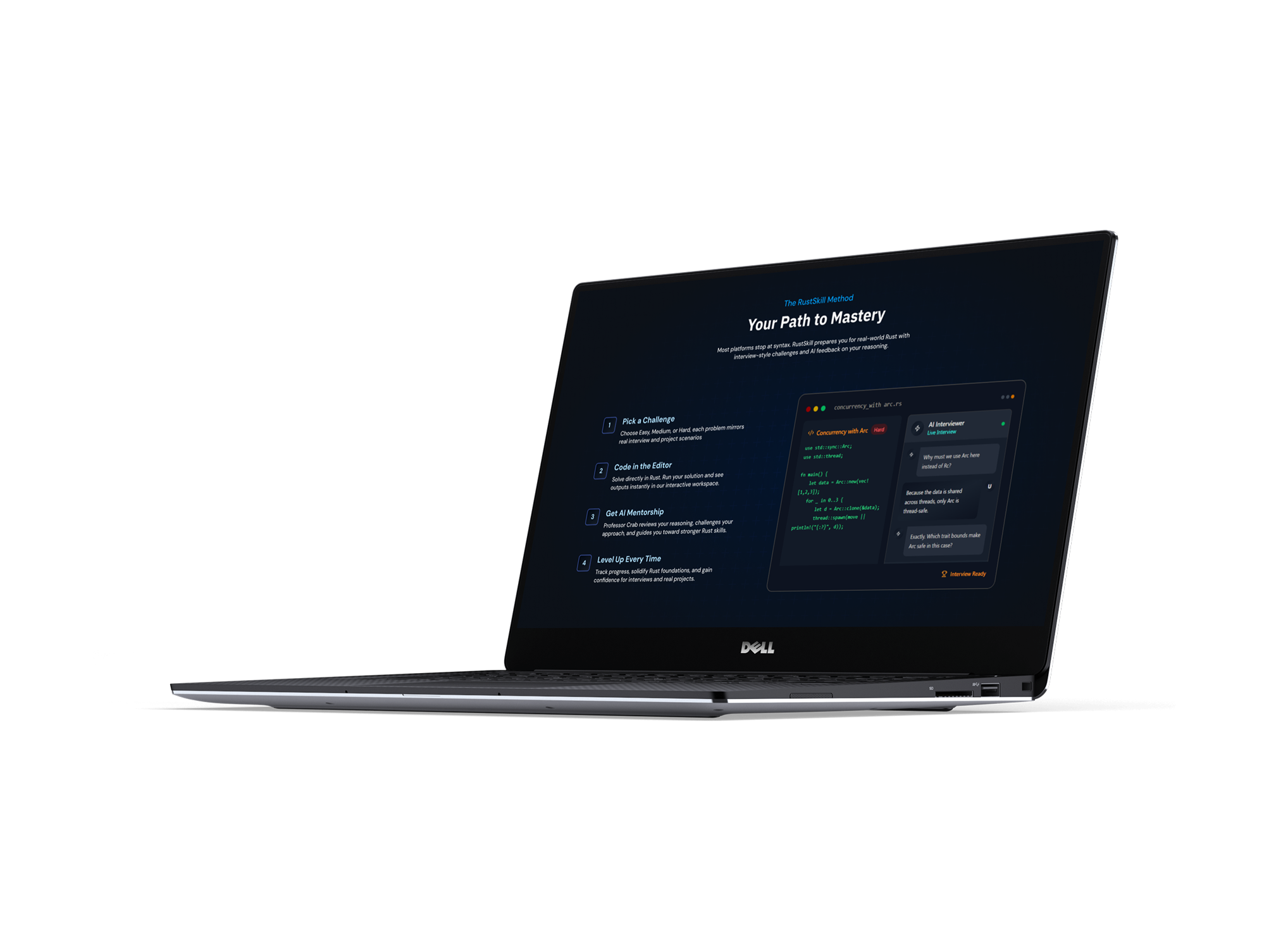
Created all key flows. From onboarding to challenge creation, execution, AI evaluation, dashboards, and analytics.
The goal: powerful tools in a predictable, simple UI.
4
Build a developer-focused design system
Defined a dark, technical UI with reusable components, clear hierarchy, and consistent states (run, error, results). Inspired by IDEs to feel familiar and trustworthy.
Inspired by IDEs to feel familiar and trustworthy.
5
Integrate AI with transparency
AI summarises insights and highlights issues but never hides the underlying code or logic. Hiring managers always see the full picture.
Hiring managers always see the full picture.
6
Establish a modern, recognisable identity
Developed a distinct aesthetic using dark mode, subtle depth and neon accents, clean, technical, and premium.
Outcome
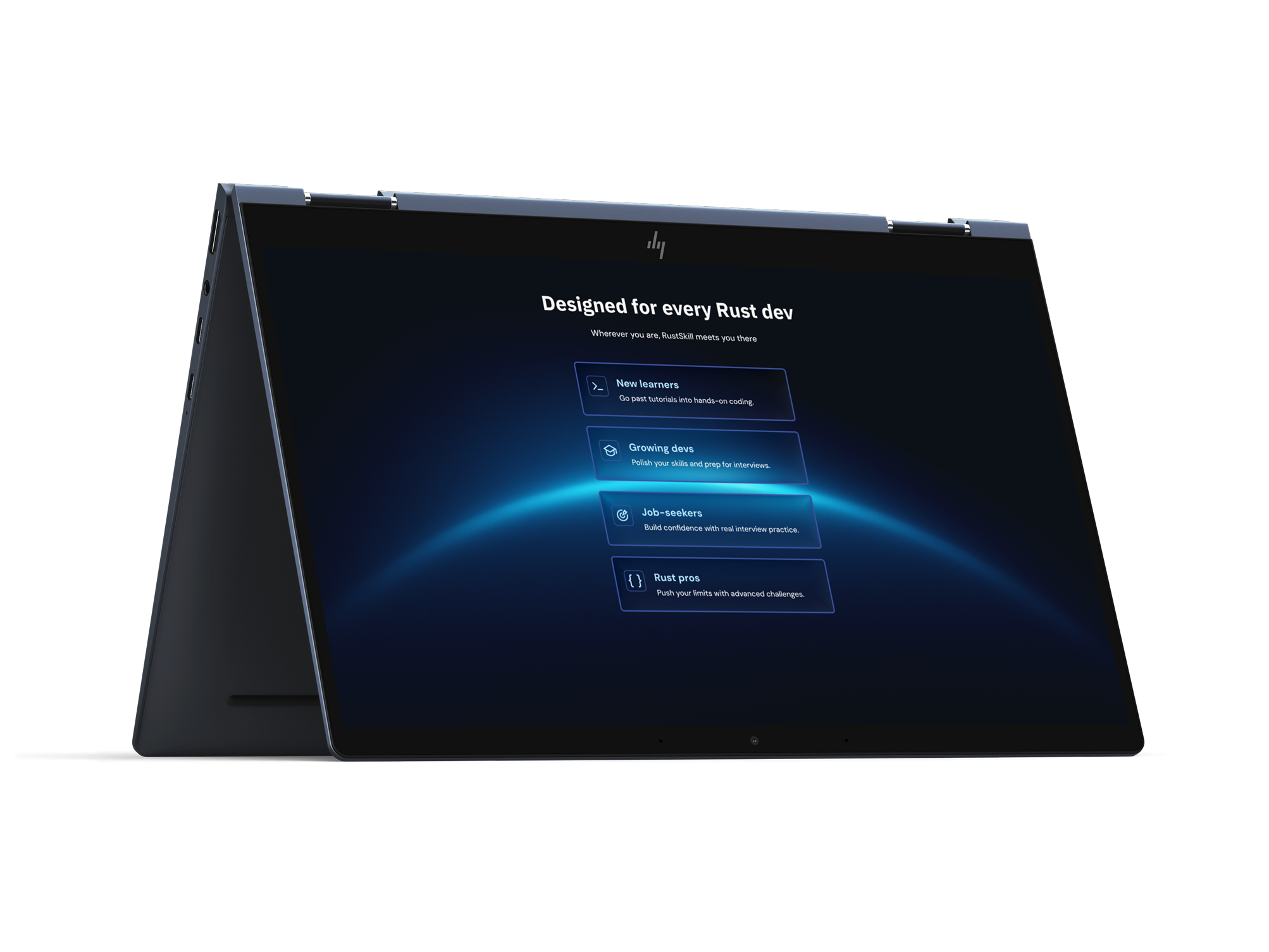
RustSkill delivers a developer-first assessment platform built around clarity and realism:
It delivered
Real Rust execution instead of theoretical quizzes
Fast, frictionless candidate experience
Clear insights for engineering teams
A scalable foundation for new challenge types and future features

Back to Portfolio
Want to check other projects?
View MySantander
View Hipoges
Back to Portfolio
AI Platform
Developer Tools
Assessment
RustSkill
An AI-powered technical assessment platform built for real Rust coding evaluation, with a modern developer-focused interface.

Context
Technical assessments rarely evaluate real skills. Most platforms rely on theoretical quizzes, generic challenges, or workflows that demand unnecessary engineering time. Candidates also face slow, unclear, and often irrelevant testing experiences.
RustSkill solves this by offering a real coding environment, powered by AI insights, in a clean and transparent interface.

Role
UX Designer, UI, IA, flows, visual identity.
Timeline
2025
Team
Independent project (with developers collaboration)
Scope
Full product creation: onboarding, challenge builder, code execution interface, AI evaluation layer, dashboards, admin tools.
Impact
Defined the entire product experience for an AI-powered learning platform—from the core journeys to the interaction patterns—creating a clear, motivating workflow that helps developers practice Rust with real-time reasoning feedback. Built a scalable design system, streamlined the challenge flow, and shaped an interface that makes complex technical learning feel intuitive and actionable.
Challenges
For companies
No accurate Rust-specific evaluation tools
Manual review consumes engineering time
Scoring is inconsistent or opaque
Difficulty comparing candidates objectively
For candidates
Long, unclear assessment processes
Poor or no feedback
Outdated interfaces that add friction
Tests that don't reflect real work
My approach
1
Map the real workflow
Studied hiring practices and developer frustrations to identify the true gap: a fast, transparent, real-code assessment experience.
2
Define core product principles
Identified common tasks, eliminated redundant steps, and reorganised the information architecture around clarity and standardisation. Goal: one platform tha t adapts to multiple departments without fragmenting the experience.
3
Design the end-to-end experience
Created all key flows. From onboarding to challenge creation, execution, AI evaluation, dashboards, and analytics.
The goal: powerful tools in a predictable, simple UI.
4
Build a developer-focused design system
Defined a dark, technical UI with reusable components, clear hierarchy, and consistent states (run, error, results). Inspired by IDEs to feel familiar and trustworthy.
Inspired by IDEs to feel familiar and trustworthy.
5
Integrate AI with transparency
AI summarises insights and highlights issues but never hides the underlying code or logic. Hiring managers always see the full picture.
Hiring managers always see the full picture.
6
Establish a modern, recognisable identity
Developed a distinct aesthetic using dark mode, subtle depth and neon accents, clean, technical, and premium.
Outcome
RustSkill delivers a developer-first assessment platform built around clarity and realism:
It delivered
Real Rust execution instead of theoretical quizzes
Fast, frictionless candidate experience
Clear insights for engineering teams
A scalable foundation for new challenge types and future features
Back to Portfolio
Want to check other projects?
View MySantander
View Hipoges
Back to Portfolio
AI Platform
Developer Tools
Assessment
RustSkill
An AI-powered technical assessment platform built for real Rust coding evaluation, with a modern developer-focused interface.

Context
Technical assessments rarely evaluate real skills. Most platforms rely on theoretical quizzes, generic challenges, or workflows that demand unnecessary engineering time. Candidates also face slow, unclear, and often irrelevant testing experiences.
RustSkill solves this by offering a real coding environment, powered by AI insights, in a clean and transparent interface.

Role
UX Designer, UI, IA, flows, visual identity.
Timeline
May 2025 - August 2025
Team
Independent project (with developers collaboration)
Scope
Full product creation: onboarding, challenge builder, code execution interface, AI evaluation layer, dashboards, admin tools.
Impact
Defined the entire product experience for an AI-powered learning platform—from the core journeys to the interaction patterns—creating a clear, motivating workflow that helps developers practice Rust with real-time reasoning feedback. Built a scalable design system, streamlined the challenge flow, and shaped an interface that makes complex technical learning feel intuitive and actionable.
Challenges
For companies
No accurate Rust-specific evaluation tools
Manual review consumes engineering time
Scoring is inconsistent or opaque
Difficulty comparing candidates objectively
For candidates
Long, unclear assessment processes
Poor or no feedback
Outdated interfaces that add friction
Tests that don't reflect real work
My approach
1
Map the real workflow
Studied hiring practices and developer frustrations to identify the true gap: a fast, transparent, real-code assessment experience.
2
Define core product principles
Focused on three core principles: assessing real Rust execution, minimizing friction at every step, and providing structured, meaningful feedback. Everything else in the experience is built around these foundations.
3
Design the end-to-end experience
Created all key flows. From onboarding to challenge creation, execution, AI evaluation, dashboards, and analytics.
The goal: powerful tools in a predictable, simple UI.
4
Build a developer-focused design system
Defined a dark, technical UI with reusable components, clear hierarchy, and consistent states (run, error, results).
Inspired by IDEs to feel familiar and trustworthy.
5
Integrate AI with transparency
AI summarises insights and highlights issues but never hides the underlying code or logic.
Hiring managers always see the full picture.
6
Establish a modern, recognisable identity
Developed a distinct aesthetic using dark mode, subtle depth and neon accents, clean, technical, and premium.
Outcome
RustSkill delivers a developer-first assessment platform built around clarity and realism:
It delivered
Real Rust execution instead of theoretical quizzes
Fast, frictionless candidate experience
Clear insights for engineering teams
A scalable foundation for new challenge types and future features
Back to Portfolio
Want to check other projects?
View MySantander
View Hipoges